
Loudness Adaption – The Louder the Better?
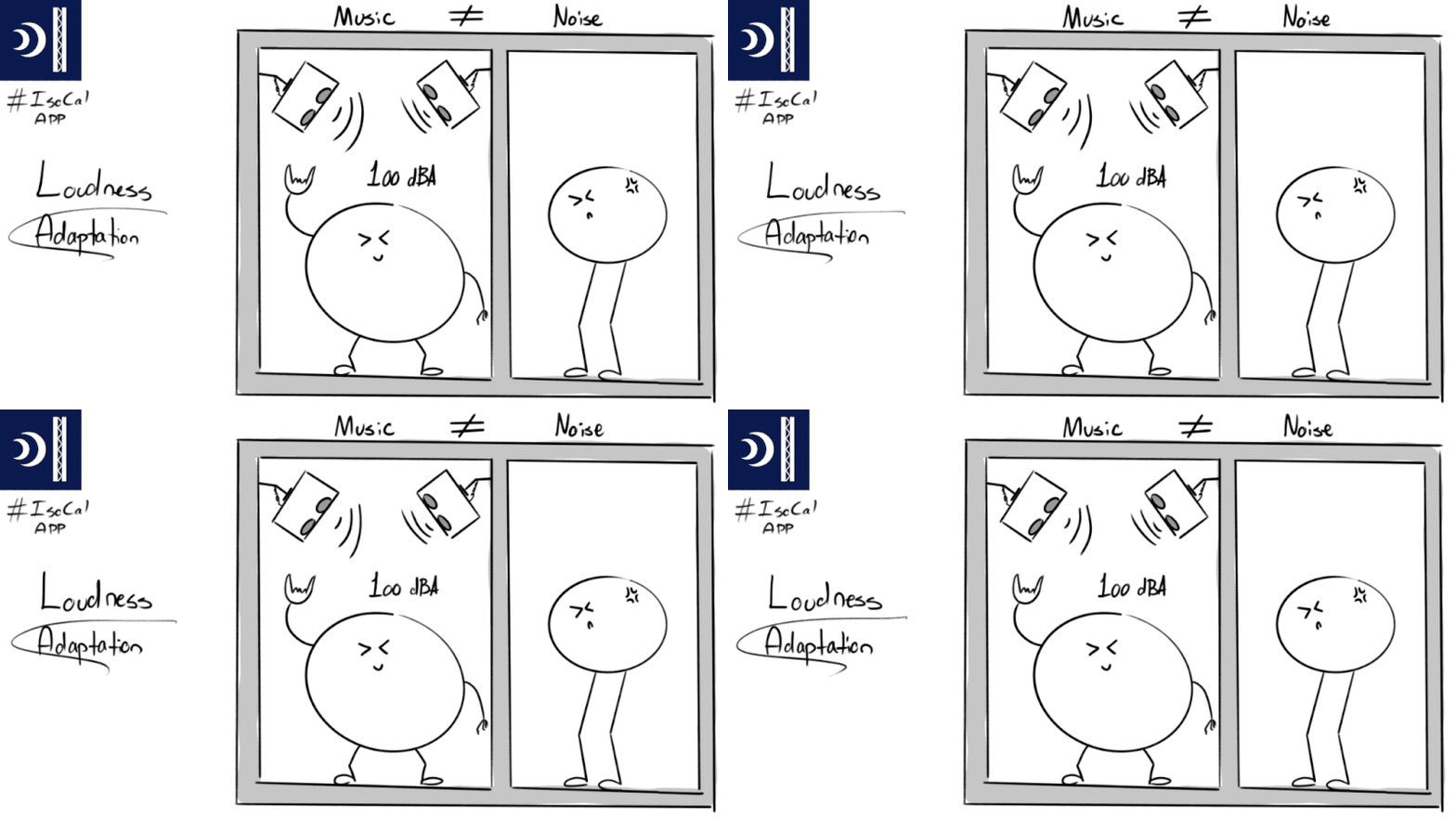
I recently fell over a page in “An introduction to the psychology of hearing” by Brian C J Moore
“
In fact, since 1972 sound levels have tended to increase, as amplifiers have become more powerful and loudspeakers more efficient. Nowadays many rock bands produce sound levels reaching 120 dB SPL among the audience.
Suprisingly, Alexsson et al. (1995) reported that many pop/rock musicians who had been performing for many years had essentially normal hearing, and only a few had a mild high-frequency loss. They speculated that there might be a protective effect of the ‘generally positive attitude of the musicians toward their performance’. Similarly in a review, Dibble (1995) concluded that “The weight of evidence suggests that Music … is nowhere near as damaging as … conventional industrial noise”. He remarks further that “there is also a body of evidence to support the … Notion that sound which is pleasing, and therefore less stressful, May also be less damaging.
It should be noted, however, that musicians who develop hearing loss often stop practicing as musicians. Therefore, the musicians studied by Alexsson et al. May have been a biased sample.
Altough Music May be less damaging than “noise”, there are nevertheless clear indications that Music Can damage hearing if the sound level is great enough and the exposure is Long enough.
…
An exposure to a sound level of 85 dBA for 8 h Per day is considered to be safe. If the exposure duration is halved, the permissible sound intensity is doubled, corresponding to a 3-dB increase in level. Thus 88 dB is permissible for 4 h, 91 dB for 2 h, 94 dB for 1 h, 97 dB for 30 min, 100 dB for 15 min.
“
Makes you Think